

Summary: Florida has the jobs, the growth and the sunshine. What nearly half of its households do not have is enough income to cover housing, food, child care, transportation and health care at the same time. An estimated 47 percent of Florida's 8.9 million households fall below the threshold of financial survival, a rate that ranks the state 48th in the nation. This article explains the issue, why Florida's nonprofit sector cannot absorb it alone, how private philanthropy is uniquely positioned to help, and how the Figgers Foundation, a Florida founded and Florida focused foundation, is leading by example.
The issue: working, and still unable to make ends meet
The most useful measure of financial hardship in Florida is not the poverty line. It is the ALICE threshold, short for Asset Limited, Income Constrained, Employed. It measures the minimum income a household needs to afford the basics in the county where it lives.
By that measure, the most recent statewide analysis found that in 2023:
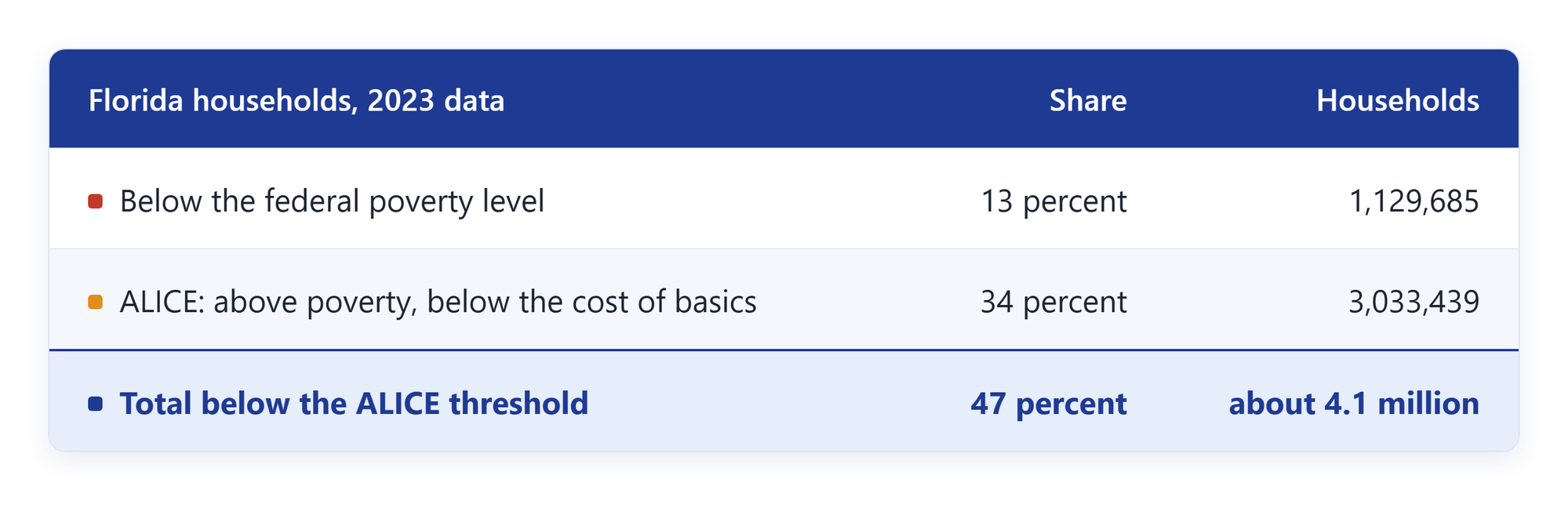
Florida's 47 percent places it 48th among the 50 states and the District of Columbia, where first place is the lowest rate of hardship. The problem is also growing faster than the state. Since 2010, the number of Florida households increased by 27 percent, while the number of ALICE households increased by 31 percent.
The people in these households are working. In 2023 the majority of Florida adults were employed and most households had at least one worker, yet only 21 percent of the population age 16 and over had the security of a full time job with a salary. Among workers in Florida's 20 most common occupations, 36 percent lived in households below the ALICE threshold, with rates at 50 percent or higher for cashiers.
Housing is the breaking point. Among Florida renter households below the threshold, 78 percent were rent burdened, meaning they paid 30 percent or more of their income on housing. Fifty four percent of homeowners below the threshold were housing burdened as well. And hardship lands hardest at the two ends of life: 69 percent of the youngest households and 55 percent of the oldest households in Florida fell below the threshold, compared with 42 percent of households headed by someone 25 to 44.
A household in that position does not need a definition. It needs a car repair paid, a ramp built, a grocery bill covered in December, a scholarship that gets a child to campus. Those are precisely the needs that fall between the cracks of public assistance, because an ALICE household often earns too much to qualify.
Why Florida's safety net cannot absorb it alone
Florida's nonprofit sector is a major economic force. The latest statewide economic impact study counts 23,224 nonprofit organizations employing more than 517,000 people and generating $140.4 billion in revenue. For every job in the sector, another 1.9 jobs are supported elsewhere in the economy.
Measured against the state's size, however, the sector is small. Florida ranks 43rd in the nation in nonprofits per 1,000 households, with 2.6, and 40th in nonprofit revenue generated per capita. A state that ranks 48th in household hardship and 43rd in nonprofit density has a structural gap between need and capacity, and the numbers show it widening. In 2025, 31 percent of Florida nonprofits reported increased demand for their services, and almost 49 percent served more clients than the year before.
How philanthropy helps solve it
Private philanthropy cannot replace public programs, and it should not try. What it can do, in Florida specifically, is the work that public programs are not designed to do.
Reach the people formulas miss. Philanthropic assistance is not bound by an income cutoff. It can help the ALICE household that earns $400 too much for a benefit and $4,000 too little to survive a crisis.
Move fast. A foundation can approve a scholarship in 30 days or build a ramp for a paralyzed mother before Christmas. Public systems are built for scale and accountability, not speed.
Solve the specific problem. A grocery gift card, a custom ramp sized to a doorway, a turkey for a family of six. Targeted help often costs less and lands better than general aid.
Use local knowledge. Faith leaders, teachers and neighbors know which families are struggling quietly. Philanthropy that works through them finds need that data cannot see.
Protect dignity. Choice, privacy and respect are design features, not luxuries. Families who are treated with dignity come back for the help that gets them to the next step.
Multiply through volunteers. Dollars given to a Florida nonprofit are stretched by volunteer hours that never appear on a balance sheet.
The Figgers Foundation leading the charge
The Figgers Foundation was built in Florida, by a Floridian, for exactly this gap. Its founder and board chair, Freddie Figgers, was raised in Quincy in Gadsden County, one of the state's most economically challenged communities, before building a Florida technology company and establishing the Foundation. The Foundation's programs center on strengthening education and expanding opportunity, and its working principle is a short one: Rise By Lifting Others.
Every item on the philanthropy list above has a Florida example in the Foundation's record.
Reaching the people formulas miss. The Hidden Figgers Scholarships are awarded each year to as many as 50 outstanding Florida high school seniors from low income households, with awards of $500 to $2,000 focused on job skill training that gets students workforce ready, applied to the fees, books and transportation costs that aid formulas tend to leave uncovered. Applicants are notified within 30 days.
Moving fast and solving the specific problem. Through Help Everyday People, the Foundation built a custom ramp for Joyce Fields-Redding, an 88 year old retired school librarian in Quincy, restoring her independence at home, and delivered a wheelchair ramp at Christmas to April Stevens, a Wakulla County mother paralyzed in a car crash months earlier.
Using local knowledge. In Quincy, the Foundation worked with faith based leaders who assessed need in advance, then distributed roughly 700 Thanksgiving turkeys, 14 to 18 pounds each, to families who had signed up.
Protecting dignity. In Broward County, the Foundation's Figgers Feeding Families initiative provides grocery gift cards to eligible households for food, essentials and holiday meals, so families choose their own groceries rather than receiving a prepacked box, with eligibility verified securely and privately.
Multiplying through partners and volunteers. The Foundation has invited businesses, faith leaders and community partners across Broward County to join Figgers Feeding Families, and its volunteers unload food, deliver bicycles and holiday turkeys, build ramps and visit seniors in Tallahassee during the holidays.
The Foundation also charges nothing for its programs. Its education programs carry no tuition or fees, and its assistance arrives as the thing itself, a card, a ramp, a check to a college, rather than a referral.
What leading the charge looks like in practice
Leadership in Florida philanthropy is not measured by the size of a gala. It is measured by whether a foundation goes where the data points and stays. The Figgers Foundation's footprint lines up with Florida's hardship map: the Big Bend and Panhandle counties where rural poverty and child hunger are highest, and the South Florida counties where housing costs push working families under the ALICE threshold. Its programs are built around the specific failure points in a working family's budget, and they are designed to be repeated, not announced once.
The Foundation is also candid about scale. No single organization will move Florida from 48th to first. But a foundation that puts up to 50 students a year on the path to a workforce credential, feeds hundreds of families in a county with the state's highest child hunger rate, and restores mobility to people who would otherwise be trapped at home is changing the way help arrives in Florida: faster, closer, with more dignity, and with a relationship attached.
Looking ahead
The Figgers Foundation is continuing its scholarship, food assistance and Help Everyday People programs across Florida through the 2026 holiday season and is seeking business, faith and community partners, particularly in Broward County and the Big Bend region. Floridians who want to help close the state's affordability gap can learn more at figgersfoundation.org/get-involved or call 1-800-391-2803.
The Figgers Foundation is a 501(c)(3) nonprofit organization founded by Florida inventor and entrepreneur Freddie Figgers. Its programs center on strengthening education and expanding opportunity for individuals, families and children, with scholarships, food assistance, direct help for everyday people and holiday programs serving communities across Florida.