
Summary: Florida had roughly 427,000 open positions in late 2025, and the shortages run deepest in the skilled trades and health care jobs that do not require a four year degree. What they do require is training, and for a senior from a low income household the cost of a career certificate program, its tools and its licensing exams can be the only thing standing between graduation and a paycheck. The Hidden Figgers Scholarships, awarded by the Figgers Foundation to as many as 50 outstanding Florida high school seniors each year, focus on exactly that: job skill training that gets students workforce ready, fast, with awards of $500 to $2,000 that can be applied to tuition, fees, books, transportation and the personal costs of a program.
Florida's jobs are waiting. Its pipeline is not keeping up.
Florida has one of the strongest labor markets in the country, and employers cannot fill it. Workforce officials counted approximately 427,000 open positions across the state in late 2025, with contractors reporting the hardest hiring in electrical work, welding, heating and air conditioning, pipefitting and heavy equipment operation, and shortages extending into health care and hospitality. Nearly every one of Florida's 30 highest demand careers, the ones with above average pay and strong growth, requires education or training beyond a high school diploma.
The state's high schools are producing graduates at a record pace. Florida's public high school graduation rate reached 92.2 percent with the class of 2025. The problem is the next step. Only 53.9 percent of the class of 2024 enrolled in any education after high school, down from 54.2 percent the year before, and the county level rate ranges from 24.1 percent to 66.6 percent. Florida's goal is for 60 percent of working age residents to hold a high value credential or degree by 2030. The state stands at 54.8 percent.
A four year degree is not the only way to close that gap, and for many students it is not the best way. A career certificate in a licensed trade or a health care occupation can often be completed in about a year, costs a fraction of a university education and leads directly to a job that is open today. Yet even that path is out of reach for a family that cannot cover the up front costs.
What job skill training actually costs in Florida
Florida keeps technical college tuition low. For the 2026 to 2027 year, the standard tuition for career certificate programs at the state's public technical colleges is $2.33 per contact hour for Florida residents, with optional fees that can add up to $0.45 per hour. Tuition, however, is only the start. Books, supplies, uniforms, tools, lab fees and industry certification or licensing exams are what push a program's real cost up. One Florida public technical college in Pasco County publishes the following estimated total program costs for 2026 to 2027, including tuition, fees, exams, supplies and textbooks:
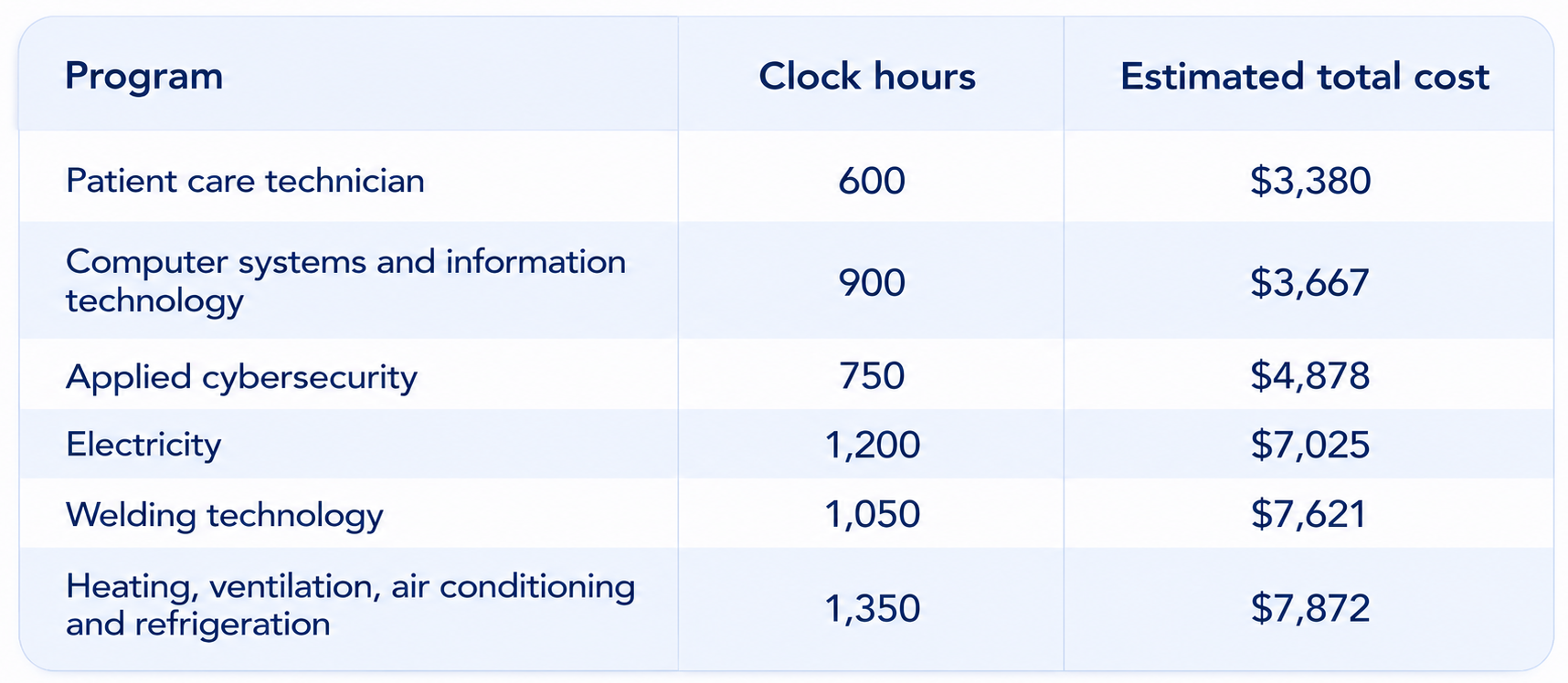
For a student from a household already below the cost of basics, those totals are not abstract. A set of tools can run several hundred dollars. A certification exam has a fee. A program across the county requires gas or a bus pass every day for a year. Students who clear the tuition hurdle can still be forced out by the smaller costs, and the state loses a worker it badly needs.
The Figgers response: a scholarship built for workforce readiness
The Hidden Figgers Scholarship program is the Figgers Foundation's answer. Each year the Foundation awards scholarships to as many as 50 outstanding Florida high school seniors from low income households. The Foundation's focus is workforce job skill training: programs that teach a marketable skill, lead to an industry credential or license, and put a graduate directly into a paying career. Scholars may also apply the award toward a college or university program, but the design goal is to make a student workforce ready as quickly as possible.
Scholars receive $500 to $2,000, to be used toward tuition at a college, university or career and technical education program. Eligible costs include tuition, fees, room, board, books and transportation, and may include other personal costs, which for a trade or health care student can mean the very expenses that typically end a program early. Measured against the costs above, a $2,000 award covers more than half of a patient care technician program and more than a quarter of an electrical program, and it is often enough to cover a program's certification exam fees and basic tools and supplies.
The scholarship is highly selective, and it rests on a premise stated plainly on the Foundation's program page: removing financial barriers allows high potential students from low income homes to excel in their coursework, complete their program and keep leading long after they finish. Funding is only part of the commitment. The Foundation engages with its scholars in a variety of ways after the award to make sure they have access to the resources and services they need as they move through training and into work.
The program's name reflects its purpose. The students it serves are outstanding, but their potential can go unseen when money is tight. The Foundation's founder and board chair, Freddie Figgers, puts the philosophy in a single line that appears across the Foundation's work: "Don't let your circumstances define who you are."
How the program works
Basic eligibility. To apply, a student must:
Be a high school senior in the State of Florida.
Be a United States citizen, national or permanent resident.
Be in good academic standing with a minimum cumulative weighted GPA of 2.4 on a 4.0 scale, or the equivalent.
Submit a typed essay of one to two pages explaining the need for the scholarship.
What the Foundation looks for. The ideal candidate has a good academic record, demonstrated leadership such as community service or extracurricular involvement, and the personal success skills that carry a student through a demanding program: emotional maturity, motivation and perseverance.
Applicant checklist. A complete application includes the Hidden Figgers Scholarship application form, an official high school transcript, two letters of recommendation and the typed essay.
Decisions. Applications must meet all eligibility requirements to be considered. Every applicant is considered and notified within 30 days of the Foundation receiving the application, a turnaround that matters for programs with rolling start dates and tool purchases due before the first day of class.
The 2.4 GPA threshold is deliberate. Many scholarships screen for the highest test scores. The Hidden Figgers Scholarship screens for the student who has done solid work while carrying responsibilities at home, who shows up, and who has the reliability that employers in the trades and health care say they need.
What it looks like in practice
The scholarship follows the student's chosen path. Ciniya Moore, a senior at IMG Academy in Bradenton, received a Figgers Foundation scholarship to help her pursue political science and athletics at Yale University. For many other scholars, the path is shorter and runs straight into a Florida job site, clinic or server room. In both cases the Foundation's role is the same: make sure the final financial step does not hold a capable Florida student back. Past recipients are featured in the Foundation's video archive, and the Foundation continues to follow its scholars after high school.
Why this matters for Florida
Every Hidden Figgers scholar who completes a training program and goes to work does three things at once. The scholar fills one of Florida's hundreds of thousands of open positions, moves the state closer to its 60 percent credential goal, and changes the earning trajectory of a family in a county where fewer than one in four graduates may continue their education at all. Scholarships at this scale do not replace public financial aid, and they are not meant to. They are designed to cover the specific, modest costs that aid formulas miss, in the programs that lead most directly to work, with a relationship attached.
Looking ahead
The Figgers Foundation continues to accept Hidden Figgers Scholarship applications from Florida high school seniors and continues to engage past scholars as they move through training and into the workforce. Counselors, career and technical education instructors and employers who know a senior with strong character and a thin bank account are encouraged to point that student to the program.
Learn more and apply at figgersfoundation.org/Scholarships. To fund the next class of workforce ready scholars, visit figgersfoundation.org/donate.
The Figgers Foundation is a 501(c)(3) nonprofit organization founded by Florida inventor and entrepreneur Freddie Figgers. Its programs center on strengthening education and expanding opportunity for individuals, families and children, with scholarships, food assistance, direct help for everyday people and holiday programs serving communities across Florida.