


Summary: The most recent national hunger research, released this summer, estimates that 15.4 percent of Floridians, roughly 3.59 million people, did not have reliable access to enough food in 2024. That includes more than 937,000 children and nearly 660,000 seniors. Florida's rate has climbed every year since 2021. With the holidays approaching, the Figgers Foundation is responding where the need is most concentrated: grocery gift cards for families in Broward County through its Figgers Feeding Families initiative, and large scale turkey distributions in Quincy, the Gadsden County community where the Foundation's founder grew up.
The numbers behind Florida's hunger problem
Food insecurity means a household cannot consistently afford enough food for an active, healthy life. It does not always look like an empty refrigerator. More often it looks like a parent skipping meals so the children can eat, a senior choosing between a prescription and groceries, or a family stretching one week of food across two.
The latest county by county estimates, which use 2024 data and were published in July 2026, show how far the problem has spread across Florida:
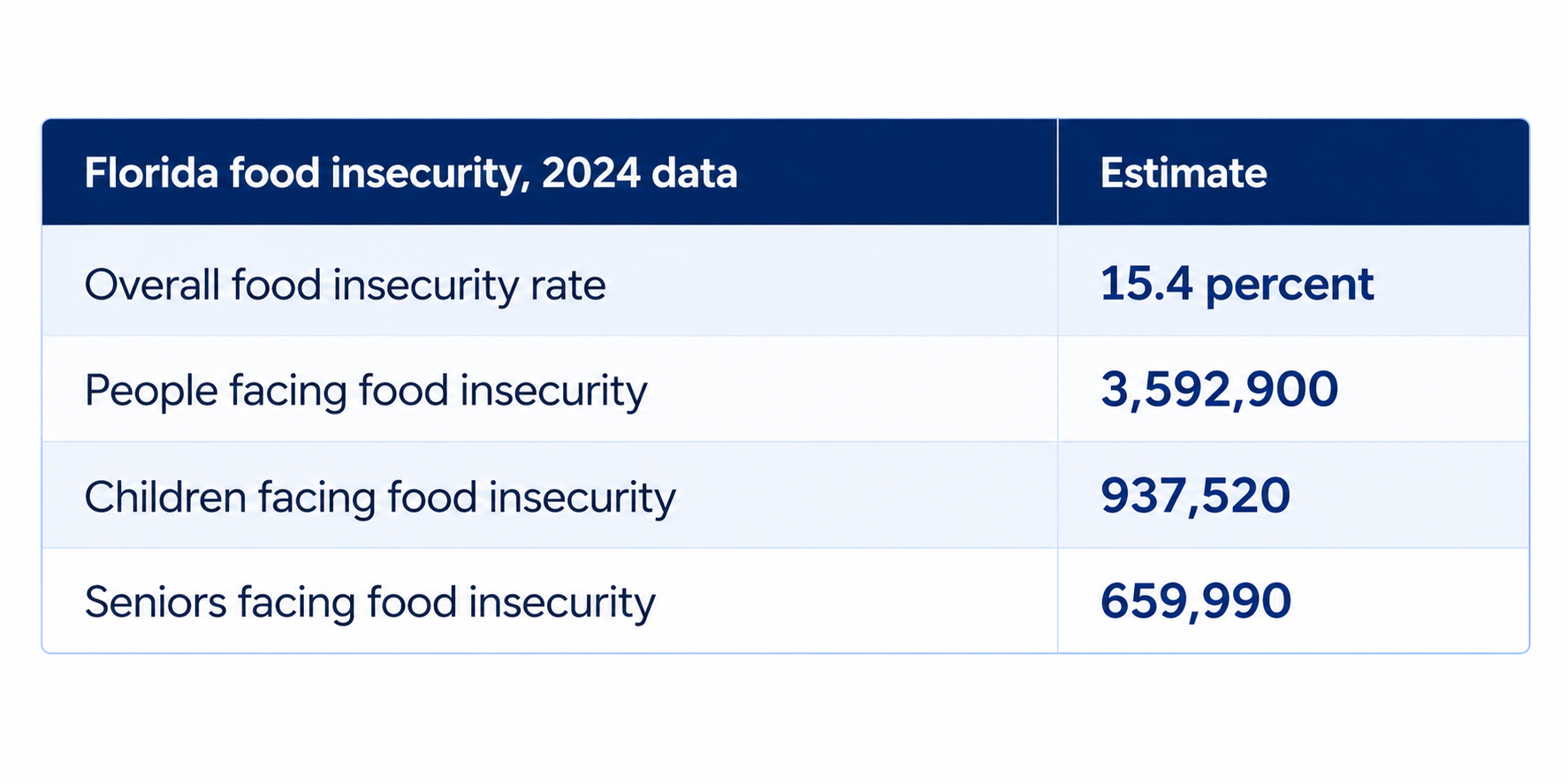
The trend matters as much as the level. Florida's food insecurity rate stood at 10.6 percent in 2021. It rose to 13.2 percent in 2022, 14.4 percent in 2023 and 15.4 percent in 2024. In three years, the share of Floridians without reliable access to food increased by nearly half.
Two forces explain most of the increase. Food prices have remained stubbornly high, with the national average cost of a meal reaching $3.70 in 2024. At the same time, nearly half of the people facing hunger nationwide may not qualify for most public food assistance because their incomes sit just above the cutoff, which means they are relying on family, neighbors, churches and charities to close the gap.
Where the need is deepest
Hunger reaches every Florida county, but it is not evenly distributed. Nationally, more than eight in ten of the counties with the highest food insecurity rates are rural, and more than eight in ten are in the South. Florida's Big Bend and Panhandle fit that pattern. In Gadsden County, 35.5 percent of children were food insecure in the most recent statewide child well being analysis, the highest rate in Florida. In St. Johns County, the best performing county, the figure was 9.1 percent. A child's odds of going hungry in Florida depend heavily on the county line.
South Florida carries the weight of sheer numbers. Broward County alone is home to nearly two million people, and the region's high housing costs leave many working families with little left for groceries by the end of the month. In Central Florida, one in five children lives in a food insecure household, and the regional meal gap grew by more than 10 percent in a single year.
The Figgers response
The Figgers Foundation's Food Insecurity and Disaster Assistance program commits the Foundation to families facing hunger and to communities rebuilding after natural disasters, from the Panhandle to South Florida. Two efforts anchor the Foundation's work on hunger.
Figgers Feeding Families, Broward County. The Foundation launched Figgers Feeding Families as a holiday initiative to help Broward County families put food on the table. Rather than distributing prepacked boxes, the program provides grocery gift cards to eligible households for food, essential items and holiday meals. Families apply, cards are distributed on a first come, first served basis, income eligibility is verified securely, and cards are picked up at the Figgers Institute.
The choice of gift cards is deliberate. A card lets a family shop for what their household actually eats, including foods that fit cultural, religious and medical needs. It lets them shop close to home, on their own schedule, without standing in a public line. And it carries no stigma. Freddie Figgers, the Foundation's founder and chairman, described the effort as more than groceries: it reminds families that they matter, that their community cares, and that better days are ahead.
The Foundation has invited businesses, faith leaders and community partners across Broward County to join the effort.
Thanksgiving turkeys in Quincy, Gadsden County. In the rural North Florida community where Freddie Figgers was raised, the Foundation has worked alongside faith based leaders to distribute roughly 700 turkeys, each 14 to 18 pounds, to families in need ahead of Thanksgiving. Community and religious leaders assessed how many turkeys were needed, and families signed up in advance so that the food reached the households that needed it most. Figgers said at the time that when people in the community need love and a helping hand, the Foundation willingly rises to the occasion, and that the goal is to help families forget, for a moment, life's trials.
Gadsden County is not a random choice. It is the county where Florida's child hunger rate is highest, and it is where the Foundation's founder was raised.
How the model works
The Foundation's hunger work follows four principles that distinguish it from a one time giveaway:
Go where the data says the need is. Broward County for scale, Gadsden County for intensity.
Work through trusted local leaders. Faith communities and local organizers know which families are struggling quietly and can confirm need without humiliating anyone.
Preserve dignity and choice. Grocery cards and preregistered distributions replace long lines and one size fits all boxes.
Time it to the moment of greatest pressure. The holidays are when a food budget breaks, and when a turkey or a grocery card does the most good.
Measurable impact
Roughly 700 families in Gadsden County received a Thanksgiving turkey through a single Foundation distribution. In Broward County, Figgers Feeding Families moves a family's grocery dollars from a charity's choices to the family's own. And because the Foundation's assistance does not depend on a public benefits formula, it reaches the working households that earn slightly too much for aid but not nearly enough to absorb a $3.70 meal multiplied across a family of four, three times a day.
What Florida can take from it
Florida's food insecurity rate rose for three consecutive years. Charities cannot reverse a statewide trend alone, but they can decide where private dollars do the most good, and the Figgers Foundation's answer is clear: the county with the highest child hunger rate, the county with the largest number of hungry families, and the weeks of the year when a food budget breaks.
Looking ahead
As the 2026 holiday season approaches, the Figgers Foundation is continuing its food assistance work across the state and is inviting Broward County businesses, faith leaders and community partners to support Figgers Feeding Families. Families, partners and donors can learn more at figgersfoundation.org/NaturalDisasterAssistance and figgersfoundation.org/figgers-feeding-families, or call 1-800-391-2803.
The Figgers Foundation is a 501(c)(3) nonprofit organization founded by Florida inventor and entrepreneur Freddie Figgers. Its programs center on strengthening education and expanding opportunity for individuals, families and children, with scholarships, food assistance, direct help for everyday people and holiday programs serving communities across Florida.